

 28 Jul 2008

New design concept furnishes young minds with inspiration as Debut UK project takes off.
“Designing spaces for children means, first and foremost, creating a space of life and of the future.” – Carla Rinaldi, Reggio Children –
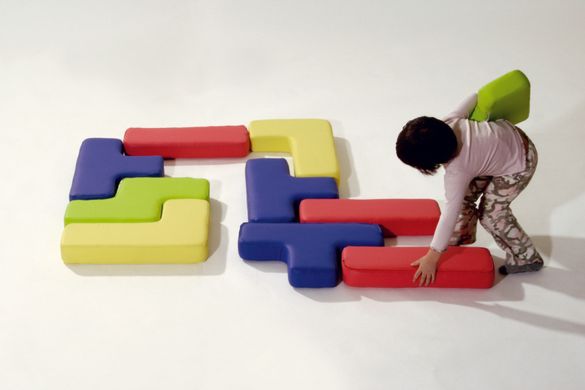
A unique collaboration of international design talent and child development experts are behind a new concept set to revolutionise the way children engage with and are inspired by their environment - in particular public play spaces – with its debut UK installation now in place within London's Heathrow Terminal 5 (T5).
The concept, PLAY+SOFT (PLAY+) is a range of soft furnishings created following a study by renowned Italian education consultancy, Reggio Children, which explored the correlation between design and child development as part of an initiative to provide high quality pre-school environments in Italy's Reggio Emilia region. Founded on the belief that kids deserve great design as much as adults – and following success across Italy - Feelgood Designs (www.feelgood-designs.com) is working in partnership with the creators of PLAY+ to make the product range readily available in the UK, marking the first in a series of design led projects based on education research. As part of an innovative consultancy service, Feelgood Designs aims to help organisations, such as BAA, deliver stimulating play spaces that both inspire children's learning and sensory development, and enhance what is often an overlooked recreational area.
In line with its selection of cutting edge design outlets and suppliers, the play areas at T5 illustrate the close work between its design team and PLAY+ to create a cuttings edge facility for children and parents. Founder of Feelgood Designs, Matthew Giaretta, explains, “Long journeys and travel can be very taxing for young children, and their parents, and there are too few public areas which respond to this. The play spaces at T5 have been carefully designed with this in mind. They are a completely new kind of respite space providing both a sense of calm and stimulation when it is most needed. Appealing to children's sense of adventure, they also represent a model that could be integrated into airports worldwide.”
A result of Reggio's study 'Children, Spaces, Relations' (1998), PLAY+is inspired not only by the experience of the Municipal Infant-toddler Centres and Pre-schools of Reggio Emilia and the pedagogical philosophy of Loris Malaguzzi, but the collective expertise of leading designers and architects including James Irvine, Andrea Branzi, Harry Koskinen, Michele Zini and Giulio Ceppi (the latter are both professors of architecture and industrial design at Politecnico di Milano), and Reggio Children consultants, Vea Vecchi and Carla Rinaldi. Today PLAY+ continues as a live research project with the aim to introduce greater complexity and apply more attention to the aesthetics of children's environments, founded on their responses to environmental stimuli, the way they children play and explore, and how they interact within spaces.
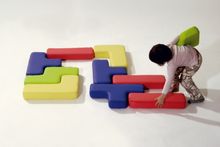
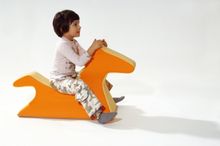
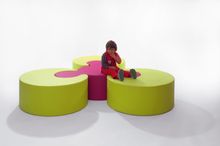
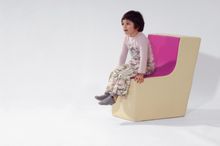
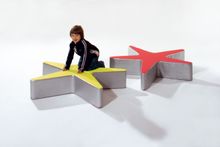
Inspired by the study, the products are designed through the eyes of a child rather than an adult's perspective, which can often over-simplify a child's innate learning ability and imagination and result in a prescriptive, non-challenging and patronising environment. Instead, PLAY+ products – in all of their flexible forms, varied textures and shapes, and soft yet complex colour ranges - are designed to open up many interpretations, stimulate a range of senses and ultimately to encourage children to explore and interact within a safe and secure environment. In turn, architect, Michele Zini, believes this experience will help improve a child's play based thinking and aid cognitive development -“(becoming) an integral part of learning, an active element in defining their identity.”
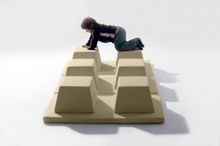
Features synonymous with PLAY+ products include the introduction of pliability, softness and elasticity offering an alternative for places that are often composed of few and hard edged materials. The premise is that a rich material landscape supports children in their learning adventure providing a nurturing environment to help them develop sensory perceptions and the construction of knowledge.
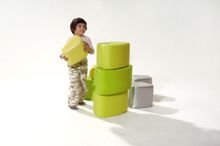
The range of colours used are sunny and bright and far from the banal world of red-yellow and blue. Instead they are designed to enrich children's chromatic landscape.
“Children have a natural love for colour and respond to it spontaneously. In general, adults tend to view bright, saturated colours as the most appropriate chromatic elements for children's things, through there is no certainty that this corresponds to children's own choices…the research conducted in the Reggio Emilia preschools shows a broader and more variable range of colour preferences.” Reggio Children: Children, Spaces, Relations (1998).
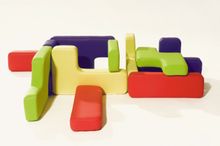
Flexibility is also key, with pieces designed to change shape and size to encourage exploration and to ensure they can adapt to fit with learning progression – whether usage spans the same day or a whole year. This ensures an evolving material landscape which utilises space effectively – for example the floor is the centre of attention for very young children, whereas walls at certain heights can offer varied and exciting exploratory experiences for older children.
Soft and pliable to protect children from accidental impacts and falls, the products are covered in ecosoftx - easy-to-clean, water-repellent, PVC free, and environmentally friendly fabric that complies with the Oeko-Tex Standard 100 for materials in contact with the skin. All fabrics and foam are fireproof to the highest British and European standards.
“The PLAY+ design aesthetic is simple and beautiful and works in many different spaces without defining itself as 'childlike'. The 'bugs' piece by James Irvine, for example, is about being open to many interpretations, about introducing new colours, about soft tactile qualities, and also about a product that grows with the child, that is: it can be interpreted in different ways by different children.” Feelgood Designs
The adaptation of these products, from a range of over 250 designs, to a commercial or education space demonstrates both the flexible design approach and the ability to create bespoke solutions, made possible by the modular nature of products and access to a world leading team of designers. These solutions can be applied across a range of sectors including airports, schools, hospitals, retail centres, theatre workshops, museums, galleries or hotels, cafes or even people's homes.
For example, as Matthew Giaretta of Feelgood Designs, comments, “When the T5 design team contacted PLAY+ originally with the idea to incorporate standard pieces from the line into their new departure lounge spaces, what quickly developed was a shared belief in the opportunity to develop something quite new for these kinds of spaces.
“T5's designers travelled to Reggio Emilia to work with the PLAY+ design team, experiment with many of the original PLAY+SOFT prototypes, and created together a bespoke response to their particular needs - from ideas to sketches and layouts to manufacture and delivery in a matter of weeks. These new play and respite spaces value the child's (and their parents') travelling experience, while retaining strong aesthetic principles and an identity in keeping with the beautiful surroundings. I believe that this process married with these principles ensure an entirely new approach, accommodating the needs of children in public spaces.”
While T5 demonstrates its first commercial installation in the UK, PLAY+ has already built up a track record of successful showcases and pilot projects in 2007. These include an exhibition at V&A's Museum of Childhood, Southbank's London Design Festival - where Reggio's research was recognised as a continuing influence in defining guidelines for architecture and design projects - as well as BALTIC Centre for Contemporary Art, Gateshead and mima, Middlesbrough, where flexible elements are being used to create social seating and transform existing spaces. Taking off over the Atlantic, first customers include, MOMA, Berkeley science museum and Liberty Science Center in New York. Feelgood Designs believes organisations should be thinking about the bigger picture when it comes to catering for children and creating facilities that they deserve.
“We've seen the nation rally for campaigns to improve quality of life for children, most notably for health and dietary issues – and rightfully so, but it shouldn't stop there when it comes to campaigning for better standards for children, whether it's the food they eat or the environment they play in. At the moment in the UK there is no equivalent to PLAY+SOFT in terms of breadth and coherency and research context and our mission at Feelgood Designs is to transform public spaces for kids making them magical places that will inspire long term learning – something all organisations should be taking responsibility in.” Feelgood Designs Vea Vecchi of Reggio Children supports this notion: “All children have the right to beauty as a vital element of quality of life”, and believes, “this can only be achieved if there is a dialogue between pedagogy, design and children themselves.”
“We want our furnishings to embody a sort of genetic code that expresses a precise identity and can possibly influence the environments in which they are situated as well as the activities they support.”
- ends -
For further information, images or interviews with Reggio Emilia / Children project leaders, PLAY+ designers or T5 design team please contact:
Jane Walton or Frances Winn at Hundredth Monkey on 0191 230 3100 or email jane@hundredthmonkeyuk.com
Notes to Editors Feelgood Designs – company info: Trading name – 'feelgood designs' Registered company name – Feel Good Design Ltd
Managing Director: Matthew Giaretta Company number: 06460110 Vat number: 924720237
Address – 1 Rosedale Terrace, North Shields, NE30 2HP, UK +44(0)191 406 0265 - telephone +44(0)191 258 6219 - fax www.feelgood-designs.com info@feelgood-designs.com
Expert Profiles:
Carla Rinaldi Born in Reggio Emilia. In 1970 Rinaldi graduated from the University of Bologna with a degree in Pedagogy. Starting in 1971, she worked as a pedagogista with the the Municipal Infant-toddler Centers and Pre-schools of Reggio Emilia and subsequently as Pedagogical Director. Currently she is Director of the Municipal Infant-toddler Centers and Preschools system and she is Executive Consultant for Reggio Children in Italy. She is responsible for research projects being carried out in conjunction with Harvard University, the University of New Hampshire and the University of Milan. She is Vice-president of the Gruppo Nazionale Nidi-Infanzia (National Early Childhood Association) and has been a speaker at numerous seminars and conferences in Italy as well as in Europe, the U.S. and Australia. She has written articles and books on education and child development published both in Italy and abroad.
Vea Vecchi worked as an Atelierista at the 'Diana' municipal Preschool of Reggio Emilia for 30 years. She carried out pedagogical research and documentation focusing on the many languages of children, particularly visual languages and cognitive proceses. She is now pedagogical consultant for Reggio Children. www.reggiochildren.it
Michele Zini carries out professional architectural work and research in Milan and Modena. He teaches at the Faculty of Architecture at Milan Polytecnic Institute, Degree course in Design. His architectural work primarily involves designing public and community service spaces, including urban planning projects, interior design, general architecture plans and works direction. His work as a designer focuses on furnishing systems for schools, residential communities, public spaces and the home. Michele has worked in close collaboration with Reggio Children on design aspects of the preschools and Infant toddler centres in Reggio Emilia, Italy.
Maurizio Fontanili is a designer and the project leader for PLAY+ research. A second generation furniture manufacturer, Maurizio worked in consultation with Reggio Children and assembled a team of 28 international designers (including Andrea Branzi, James Irvine, Denis Santachiara, Terri Pecora, Sebastian Bergne), with the art direction of ZPZ Partners, building on the research recounted in the Children, Spaces, Relations metaproject (1998). The outcome of this new collaboration is the PLAY+SOFT line of furnishings, which aims to introduce new sensory and aesthetic qualities into environments for children.
Matthew Giaretta – founder of Feelgood Designs, representing PLAY+ products and design services. Experience as a primary teacher in the UK, including arts council creative projects inspired by training at Reggio Emilia; worked with PLAY+ on events and product sales from 200506 and now introducing products and PLAY+ approach to design projects for installations, interiors, and architecture projects in the UK and Ireland.